Let’s Work those Boundaries!
Boundaries may seem pretty obvious in terms of what they are, but when you try to put them in practice things get tricky.
What are boundaries?
Boundaries are the limits at which we no longer feel ‘safe enough’ to be in an interaction with someone else. Think of a boundary like a fence around yourself. With a stranger, that fence might be further out in terms of your physical boundary. That stranger’s age, gender, body language might also affect how physically close to them you want to be. That fence (boundary) is what allows you to feel ‘safe enough’ engaging with that person.
Why do we need boundaries?
Boundaries are protections for yourself and allow you to be in healthy relationships with others. Let’s say you’re a student leader and you want to be an emotional support for your mentee, so you answer late night texts and you meet with them regularly to process their feelings and you constantly show up for them. Not only can this lead to you feeling burnt out and overextended, over time you might feel resentment because your emotional energy is not available for other relationships; it also isn’t great for the mentee because they are not learning healthy relational limits and their own ability to self-advocate and look for resources that can meet their needs.
Emotional Markers of Boundaries
Sometimes, it can be difficult to know where your boundary is. Your emotions can be markers for boundaries. Common emotions around boundaries include:
Anger: when someone has crossed your boundary.
Resentment: when someone is repeatedly crossing your boundaries even after you’ve done some initial boundary setting (non-verbally or verbally).
Guilt: when you hold or maintain a boundary.
Let’s talk through four parts of boundary work:
1) Identifying the boundary: Sometimes, it can be difficult to know where your boundary is. See below for explanations of different types of boundaries. (see wheel below)
2) Setting the boundary: You can assert your boundaries with verbal cues or nonverbal body language, and both can be effective depending on the situation.
3) Reiterating the boundary: It is common to need to repeat yourself and reiterate your boundary before the other person respects it. For example, perhaps you start with a more indirect boundary of leaning away from the stranger, or
4) Following up the boundary: If your boundary is crossed, you can have a plan for how you can ultimately respond. You cannot control another person’s actions, but you can control how you respond. For example, the stranger from the example above ignores your non-verbal and verbal boundary (‘could you move back a bit please’), so you then leave the situation yourself and move to another space.
Use the wheel below to think about various boundaries you have, and how they change based on who you’re with and in what situation.
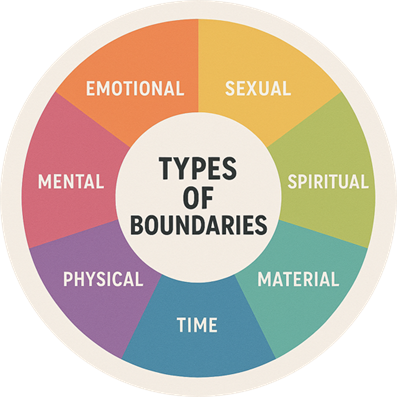 Physical: Your personal space around your body and physical touch are a part of your physical boundaries.
Example: A classmate keeps leaning over your desk and touching your belongings, so you say, “I need a little more personal space to focus. Please stay on your side of the desk.”
Emotional: Your limit of how much emotional energy you will give to a person therefore preventing you from taking on unnecessary responsibility of other people’s emotions.
Example: Your friend keeps bringing up a breakup they are going through, so you say, “I care about you, but I don’t have the emotional capacity for a long conversation while on shift. Can we talk about this later?”
Sexual: Your sexual limits can include touching, sexual comments, or discussions and conversations that are sexually loaded.
Example: While volunteering at a career fair, an employer wraps their arm around your shoulder without your consent. You tell them, “Move your hand off my shoulder.” While this can also be a physical boundary, it is layered on with your gender identity and that of the employer.
Time: Your time boundary is how much time you’re willing and able to dedicate to something. It helps you avoid overcommitting, getting burnt out, and helps with self-care and balance.
Example: You decide that you will spend 4hrs studying for a specific exam and after that, you’ll head out for a walk.
Mental: Your thoughts and ideas, and how much mental space you will give to a topic are a part of your mental boundaries.
Example: On a facetime with your sibling in the middle of a busy day you say “I can listen for a few minutes, but I don’t have the mental space for a big problem-solving conversation right now.”
Spiritual: Your comfort in discussing or expressing your spiritual or existential beliefs or personal values.
Example: Politely telling a friend, “I’m not comfortable discussing or debating my faith,” if they continue pressuring you about your beliefs.
Material: How you share or protect your possessions, money, or physical resources.
Example: Your coworker borrows money for lunch and doesn’t repay you. The next time they ask for some money for lunch, you say no.
Can you do empathy + boundary setting?
Yes! It might make you feel guilty to set those clear boundaries, especially if intentional boundary setting is a newer skill for you, but over time with some practice empathetic boundary setting becomes easier.
Think of the following equation:
naming the feeling of the other person + what you need + your action
This can sound like: “I know you’re struggling right now and I really want you to get the support you need (their feeling). I can’t keep having late night calls with you (your need) so I’ll be turning my phone on silent after 9pm (your action)”.
Or: “I know you’re working hard on this group project and that we all want to do well (their feeling). I’m feeling some resentment that I’m carrying more than my share (your need), so after this piece of the work is done I’ll be stepping back a bit so you can complete the last portion (your action)”
Final thought!
While it is not always easy, recognizing your boundaries and asserting them an important part of healthy relationships and of taking care of yourself