
Academic Programs
MScOT Program Contact Information
For more information about fieldwork and placements in the MScOT program, contact:
Erin Williams
Clinical Placements Coordinator, Rehabilitation Sector Schools
519-661-2111 ext. 88754
otclined@uwo.ca
Fieldwork & Placements
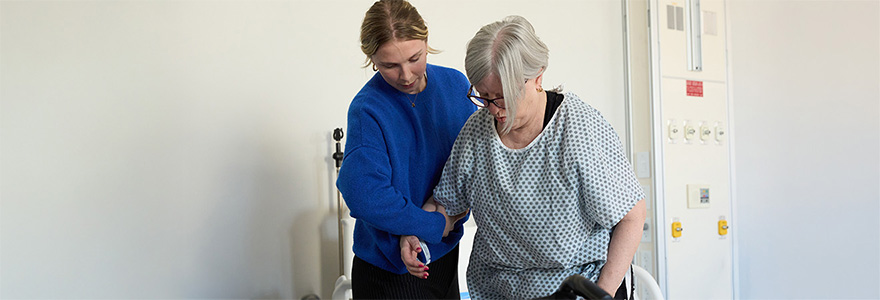
One of the most exciting aspects of the professional graduate program in occupational therapy involves fieldwork placement courses. The placement blocks occur in the fall, winter, spring, and summer terms. Placements are offered in a variety of settings in several practice areas providing students with opportunities to grow their skills and knowledge through experiential learning.
Placement Details
Western MscOT students complete four clinical placements over the course of the two-year program.
| Placement | Course # | Year of Program | Time Period | Length (wks) |
|---|---|---|---|---|
| 1 | OT9580 | 1 | Jan. – Apr. | 4 (Assigned Days for Simulation) |
| 2 | OT9581 | 2 | Nov. – Dec. | 8 |
| 3 | OT9680 | 2 | Mar. – Apr. | 8 |
| 4 | OT9681 | 2 | May – Jun. | 8 |
Students are expected to graduate with a mix of clinical placement experiences assessing and treating a diverse population of individuals and conditions across settings, areas of practice and lifespan to ensure they meet graduation requirements and are prepared for clinical practice.
Settings
- Acute Care
- Outpatient
- Day Hospital
- Public Sector
- Private Practice
- Community Health
- Rehabilitation
- Long-Term Care
- Children's Centre
People of Different Age Groups
Students work with individuals across the lifespan:
- Children (< 17 years)
- Adults (18 – 64 years)
- Seniors (> 65 years)
Placement Sites
Local – In-Catchment
The MScOT program collaborates with more than 100 clinical facilities in southwestern Ontario to offer placement experiences for OT students. Placements are arranged within the Western catchment area, which extends from Windsor in the southwest to Owen Sound in the north, and to Waterloo in the east.
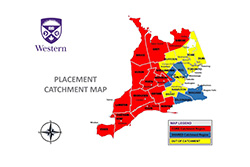 Students are required to complete placements, as arranged and assigned by the Academic Lead, Clinical Education, at any of the affiliated healthcare facilities within southwestern Ontario. Given Western’s catchment area, all students will be required to relocate for up to two placements. Examples include students relocating to Orillia, Niagara, Guelph, or Sarnia. Students must be prepared to relocate to any of these communities to complete their clinical placements and meet graduation requirements.
Please click here to view the map of the local catchment area.
Out-Of-Catchment (OOC)
Western MScOT students may have the opportunity to complete placements in other parts of Ontario or Canada. However, these placements are scarce and fully dependent on placement site availability within the catchment area of another university.
All placements must be discussed and arranged with the Academic Lead, Clinical Education. Students MUST NOT reach out to sites or other universities on their own. Students have the opportunity to complete OOC placements for the final two fieldwork placements.
Northern Ontario School of Medicine (NOSM)
Students who are looking for a unique opportunity to discover Northern Ontario are invited to apply for a NOSM placement. These placements serve people in Northern Ontario including, Francophone, Indigenous, and rural communities. Funding is provided for those who are eligible. Priority is given to students who live in Northern Ontario and plan on returning to work after graduation and have the capacity to serve these minority populations.
International
Western MScOT students can complete one international placement in their final two placements. These opportunities vary from year to year. In the past, students have completed placements in Australia, India, England, Tanzania, Ireland, and the United States.
Eligibility Criteria
Please note, the opportunity to participate in international, NOSM, and OOC placements is a privilege. These opportunities are not guaranteed and are different each placement block. Eligibility criteria:
- Students are in good academic standing with the program
- Students must not be or have been on academic probation
- Students do not have an unresolved Early Student Support Plan (ESP) related to academic integrity or professionalism (Refer to Student Handbook sections on Academic Integrity and Professional Behaviour Rubric and Guide)
- Students meet or exceed fieldwork placement expectations in previous placements.
Associated Costs and Funding
Associated Costs
MScOT students are responsible for all costs incurred related to the completion of the required fieldwork placements. Completing placements outside of London might be associated with additional costs (such as temporary housing rental, travel to/from London, parking, rental car etc).
It is a good idea to budget at least $2,000 per placement for extra costs.
Access to a vehicle during clinical placements is beneficial and strongly recommended, but not required. Many placements in community settings require a car for home visits.
Funding
Additional funding may be available through funds provided by the Ministry of Advanced Education and Skills Development (MAESD) and is subject to change.
Funding is also available through various bursaries and awards from Western's School of Occupational Therapy, School of Graduate and Postdoctoral Studies, and Society of Graduate Students.
Placement Requirements
Pre-Placement Requirements - Medical and Non-Medical
On an annual basis, MScOT students must complete pre-placement requirements which include items such as immunizations, a vulnerable sector police record check, CPR training, etc. The School of Occupational Therapy has partnered with Synergy Gateway Inc. to provide support and clearance for pre-placement requirements. Students must pass all the requirements before they begin their placement, and they must be valid for the duration of the placement. Students are responsible for all costs associated with these requirements including Synergy clearance appointments.
Students must be aware that at this time most placement partners including hospitals, long-term care facilities, and community clinics, have pre-placement policies for students that include mandatory vaccination requirements. Students will be required to be compliant with the policy requirements of our placement partners in order to attend placements in those facilities.
If students are not compliant with those policies, they will not be able to attend those placements and will fail to meet clinical graduation requirements. Students that fail to meet clinical graduation requirements will not be eligible to complete the program.
Evaluation Requirements
All fieldwork placements have an assigned course number and are graded on a pass/fail basis. Each student’s performance is evaluated by the clinical instructor at mid-term and final evaluation using the a standardized Canadian fieldwork evaluation tool. Each placement must be successfully completed to progress to the next block in the program.
Graduation Requirements
To meet graduation requirements, students must complete a minimum of 1000 hours. The range of student experiences must include:
- People with primary mental health needs
- People with physical health needs
- People of different age groups (for example: children, youth, adults, older adults)
- People who have recently acquired and/or long-standing health needs
- Interventions that focus on people, occupations, and the environment
- Various practice settings (community practice, hospital-based care, children’s centre, etc.)
Fieldwork Accommodations
Fieldwork Accommodations
Accommodation consists of arrangements that allow a student with a disability or chronic health condition a fair opportunity to engage in academic activities and fulfill essential course and program requirements. Accessible Education (AE) at Western provides support and services to students with disabilities at Western, including academic and fieldwork accommodations.
Because of the individualized nature of accommodation, students and prospective students are encouraged to meet with an Accessible Education counselor early on to obtain information about specific accommodations and services that may be available to them.
Some academic accommodations, such as those for traditional lecture-based courses, may not be suitable or appropriate when students are completing clinical placements. In such instances, accommodations that are specific and can be operationalized to learning in clinical placement contexts will need to be considered.
Students are also responsible for ensuring academic accommodations are updated each term and are in place early for clinical placements.
Clinical Placements Office
Our Clinical Placements Team assists in the planning, administration, and coordination of clinical placements. For detailed information with respect to pre-placement requirements, dates and deadlines, and frequently asked questions, please visit our web pages.