

Search Website
Woodman Speaker Series
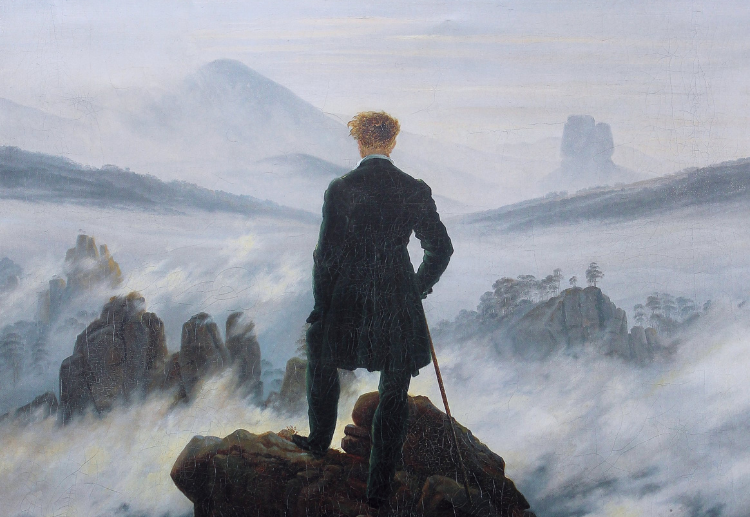
The Ross and Marion Woodman Speaker Series in Romanticism invites intellectual exploration of this movement's powerful legacy to the Humanities and beyond. Romanticism continues to cast a long shadow on our experience, especially our present time of various crises that require Romanticism's ceaseless mental flight more than ever.
Fall 2026 Speakers
Kristina Mendicino: “Unseen Blusher in an Obscene Coalhole”: On the Subject of Knowledge and Jouissance in Joyce and Shelley”
Time: Tuesday, September 29, 5:00 – 6:30 PM
Location: University College 3105 Board Room
In his session on “Lituraterre” from Seminar XVIII (1971), French psychoanalyst Jacques Lacan asks: “Isn’t the letter littoral, strictly speaking? Isn’t that what the letter traces out—the edge of the hole in the kind of knowledge that psychoanalysis designates when it approaches it?” For Lacan, not only psychoanalysis but also literary writing and mathematical formalizations demarcate this limit. Whether the formulae of physics or the “vocable scriptsigns” of Finnegans Wake, the letter marks a rupture in the ‘knowledge’ constituted by the signifier. Yet whereas letters used in science dismiss the “jouissance that stems from” this rupture, literature and psychoanalysis support a different relation to jouissance – which also means a different relation of the subject to the signifier and knowledge. This lecture addresses how the literary writings of James Joyce and Percy Shelley articulate the relation of the subject to knowledge and jouissance, focusing on the words “fading coal” from Shelley’s A Defence of Poetry, a central phrase in Joyce’s fiction.
Kristina Mendicino is Professor of German Studies at Brown University. She is the author of Prophecies of Language: The Confusion of Tongues in German Romanticism ( 2016), Announcements: On Novelty and Passive Voices (2021), and On the Subject of Phenomenology, and Other Figures of Speech (2023). She is also the editor of several volumes and special issues on topics ranging from German Idealism to modernist poetry and the literary character of phenomenology. She has just completed a monograph on the intersections and disjunctions between Lacanian psychoanalysis and Heideggerian thought, titled Of Logos: On Speaking Being in Heidegger and Lacan. In her current project, she aims to unfold the consequences of a Lacanian approach to the letter for literary studies, focusing on writers such as James Joyce, Georg Trakl, and Robert Walser.
Spring 2026 Woodman Lecture
Nathan TeBokkel: "What is it Like to be a Bee?"
Phenomenology and Romantic Forms of Estrangement
In 1974 the philosopher Thomas Nagel occasioned a paradigm shift in phenomenology with his essay “What is it Like to be a Bat?”
Nathan TeBokkel replaces “bat” with “bee” to resituate phenomenological questions, including the abiding questions of the humanities, in their entwined histories of labour, environment, agriculture, and Romantic poetry. This resituating affords a reflexive examination of phenomenology and its first-person subject, which, TeBokkel argues, is Romantic. Cultivated in fields from poetry to psychology to politics, compelled to continuously renegotiate its place in nature, this subject is a function of Romantic forms of estrangement that influenced what Marxism, existentialism, and psychoanalysis later explored as alienation. “What is it Like to be a Bee” reads this estranged subject through Romantic modes of aesthetic defamiliarization, specifically in John Keats’s great odes, in which the subject’s renegotiation of its place in nature becomes a joint artistic and agroecological endeavour. TeBokkel thus integrates his lived experience as a beekeeper, in a world reliant on insect pollination for one-third of all food crops, with Romantic poetry, which reminds us of the humanities’ vital response to economic and ecological crisis.
Dr. Nathan TeBokkel is a Banting postdoctoral fellow at Western University. He’s the past recipient of a Vanier Canada Graduate Scholarship and a Killam Memorial Doctoral Scholarship, among other academic and agricultural awards. His first book, Whistling at the Plough, forthcoming from Cambridge University Press, examines the relation between agricultural capitalism and Romanticism. His next book and the topic of his Banting project is Working Feeling, on labour history, lived experience, and Romantic poetics. TeBokkel is also training to be a master beekeeper, managing 160 hives on his family’s farm, and researching honey bee queen replacement as a technique for improving overwinter survival. His recent publications include an essay on food labels and technocratic populism in New Literary History and an essay on creative writing in The Alchemy of Stories, edited by Monika Lee and Clara Sebben.