
Surface Weather Stations
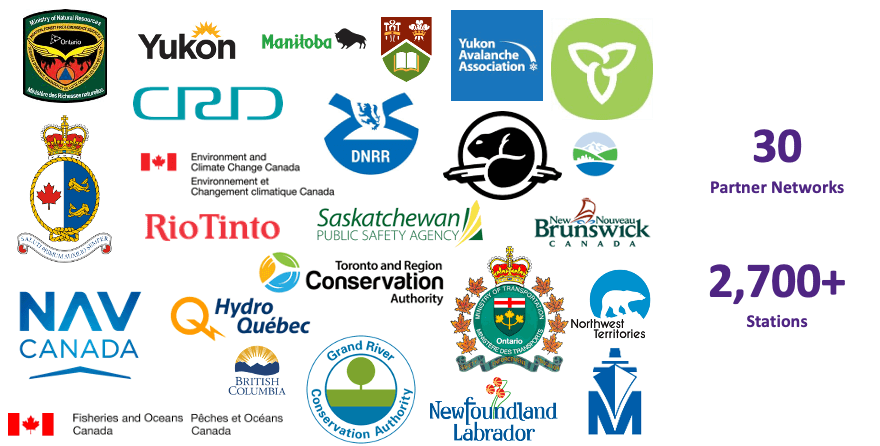
Accurate and timely surface weather data is essential for understanding severe convective storms, especially in regions with complex and dynamic climates like Canada. In-situ weather observations (those collected directly at the ground) provide critical real-time information that remote sensing tools like satellites and radars can not always capture. These observations allow us to measure temperature, precipitation, wind speed, humidity, and other meteorological variables at the earth's surface, improving our ability to detect severe convective storms.
The Northern Mesonet Project plays a vital role in centralizing and integrating these in-situ observations though the CSSL Weather Intelligence. With contributions from 40 external partners, the Northern Mesonet Project gathers data from over 3,300 surface weather stations across Canada, along with an additional 500 stations in the United States of America. This expansive network ensures that we can monitor localized weather conditions, identify trends, and improve forecasts. By combining data from government agencies, research institutions, and industry stakeholders, the Northern Mesonet Project offers an unparalleled source of weather information that is accessible to researchers, forecasters, and the general public alike.
Below is a list of our partner networks:
- Alberta Ministry of Agriculture and Irrigation (AB-MAI)
- Alberta - Ministry of Forestry and Parks (AB-MFP
- British Columbia - Captial Regional District (BC-CRD)
- British Columbia - Ministry of Environment and Climate Change Strategy (BC-ENV)
- British Columbia - Ministry of Forests - Wildfire Management Branch (BC-FOR)
- British Columbia Hydro (BC-Hydro)
- British Columbia - Metro Vancouver Regional District (BC-MVRD)
- British Columbia - Ministry of Transportation & Infrastructure (BC-TRAN)
- Department of Fisheries and Oceans (DFO)
- Department of National Defence (DND)
- Department of National Defence - Canadian Coast Guard (DND-CCG)
- Environment and Climate Change Canada (ECCC)
- Government of Northwest Territories - Department of Environment and Natural Resources - Forest Management Division (GNWT-ENR-FMD)
- Government of Northwest Territories - Department of Environment and Natural Resources - Water Resources Division (GNWT-ENR-WRD)
- Grand River Conservation Authority (GRCA)
- Hydro-Québec
- Manitoba - Department of Agriculture (MB-Ag)
- Meteorological Service of Canada (MSC)
- NAV Canada
- New Brunswick - Department of Natural Resources and Energy Development (NB-DNRED)
- New Brunswick - Department of Transportation and Infrastructure (NB-DTI)
- Newfoundland and Labrador - Department of Environment, Climate Change, and Municipalities - Water Resources Management Division (NL-DECCM-WRMD)
- Newfoundland and Labrador - Department of Fisheries, Forestry, and Agriculture (NL-DFFA)
- Nova Scotia - Department of Lands and Forestry (NS-DLF)
- Nova Scotia - Department of Public Works (NS-DPW)
- Ontario - Ministry of Natural Resources and Forestry - Aviation, Forest Fire, and Emergency Services (ON-MNR-AFFES)
- Ontario - Ministry of Natural Resources and Forestry (ON-MNRF)
- Ontario - Ministry of Transportation (ON-MTO)
- Parks Canada - Natural Resources Management Branch (PC-NRMB)
- Prince Edward Island - Department of Transportation and Infrastructure (PE-DTI)
- Port of Montreal (POM)
- RioTinto
- RTA
- Saskatchewan - Public Safety Agency (SK-SPSA)
- Saskatchewan - Public Safety Agency - Water Security Agency (SK-SPSA-WSA)
- Toronto and Region Conservation Authority (TRCA)
- University of Prince Edward Island (UPEI)
- Yukon Avalanche Association (YAA)
- Yukon - Department of Community Services - Wildland Fire Management (YT-DCS-WFM)
- Yukon - Department of Environment - Water Resources Branch (YT-DE-WRB)