


Search Website
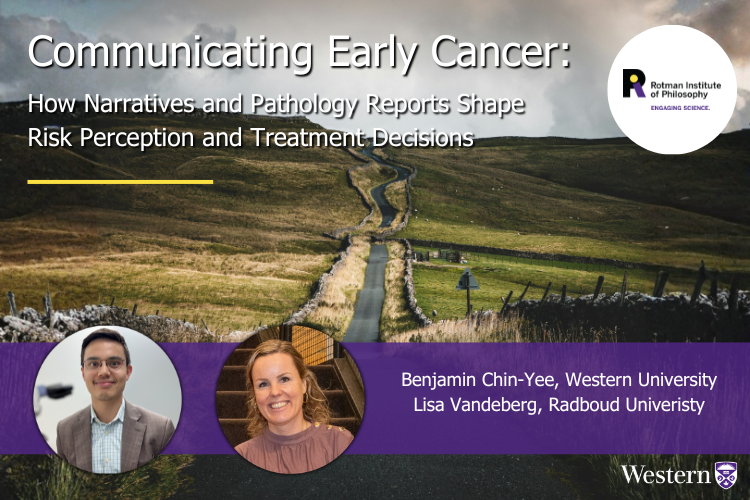
Communicating Early Cancer: How Narratives and Pathology Reports Shape Risk Perception and Treatment Decisions
Join the Rotman Institute of Philosophy as we welcome Benjamin Chin-Yee (Western University) and Lisa Vandeberg (Radboud University) for an engaging seminar: "Communicating Early Cancer: How Narratives and Pathology Reports Shape Risk Perception and Treatment Decisions"PLEASE REGISTER HERE - virtual option available
Abstract:
How a cancer diagnosis is communicated shapes how patients interpret risk and make treatment decisions, particularly in early or low-risk cancers where observation may often be appropriate. This talk will begin with recent research examining how framing in health communication (including metaphor use, (non-)occurring outcomes, scientific uncertainty) influences perceptions of disease and treatment. We’ll then present preliminary work from a collaborative project between Radboud University and Western University investigating how narrative metaphors and pathology report formats may influence risk perceptions, emotional responses, and treatment preferences. By experimentally varying communication formats, the project aims to generate evidence to support more patient-centred approaches to communicating early cancer diagnoses.
Speaker Bios:
 Benjamin Chin-Yee, Western University:
Dr. Benjamin Chin-Yee is a hematologist and Assistant Professor at Western University, Canada. He completed his PhD at the University of Cambridge, UK, as a Gates Scholar. His research bridges clinical hematology-oncology and philosophy, focusing on how technologies like genomics and AI are reshaping diagnostic reasoning, communication, and patient-centered care.
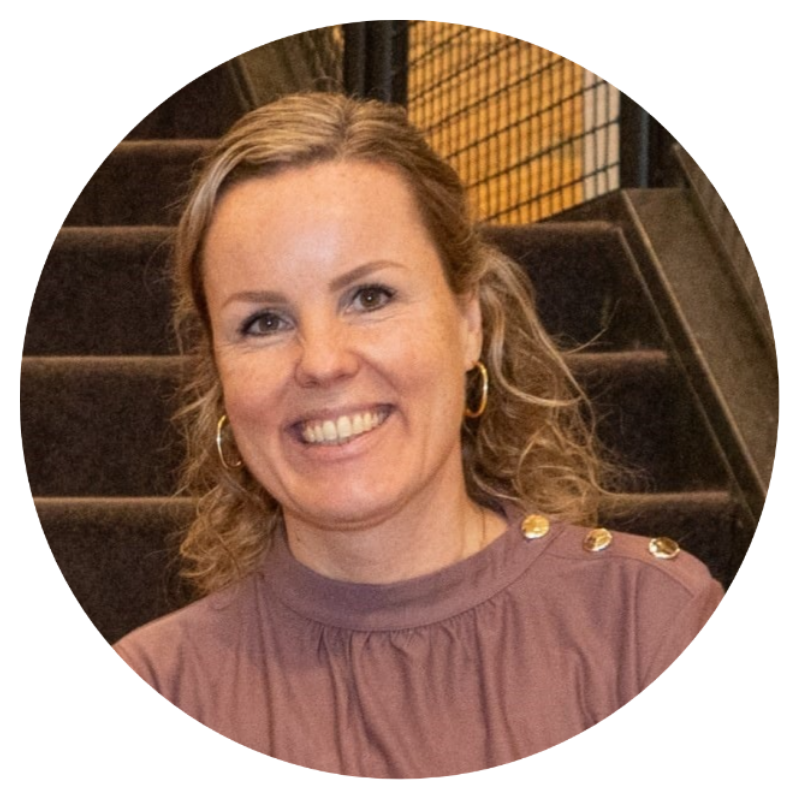 Lisa Vandeberg, Radboud University:
Lisa Vandeberg has a PhD in cognitive psychology and is an Assistant Professor in Communication Science at the Behavioral Science Institute (Radboud University, the Netherlands) and a senior researcher in the Department of Primary and Community Care (Radboud University Medical Center, the Netherlands). Combining these disciplines, she investigates whether and how different forms of health communication (e.g., about vaccination or medical uncertainty) trigger psychological processes (such as biases and resistance) that may help or hinder message comprehension and behavior change. She will introduce her own research, as well as our shared project, in which we aim to study the impact of language use in patient narratives and pathology reports on risk perceptions, emotions, and decision-making in the context of early cancer stages.