
Search Website
2026 Annual Fall Lectures: Agency & AI — Lecture One
The Rotman Institute of Philosophy is pleased to present the 2026 Annual Fall Lecture Series:
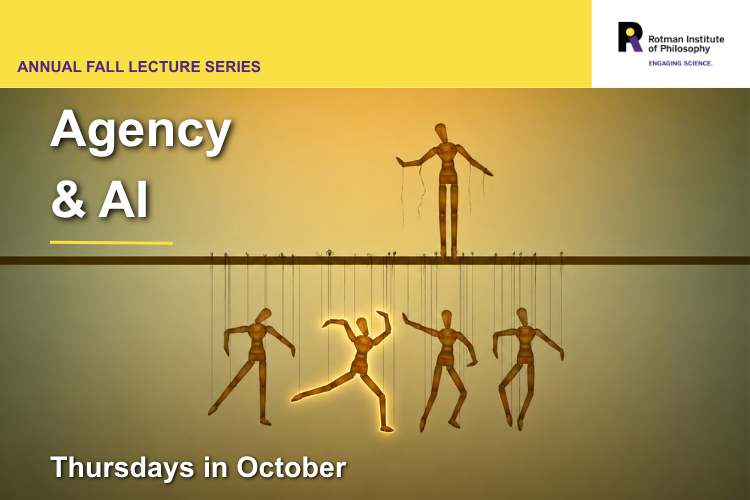
"Agency & AI"
What does human agency mean in a world where AI systems are becoming increasingly integrated into everyday life? Where does human agency begin and end? What are the risks and impacts of treating AI as agents? Can AI systems be designed to support and strengthen human agency and capacity-building rather than replace or diminish them?
This year's series brings together leading scholars and thinkers to explore these and related questions from a range of perspectives. Join us each Thursday in October for five engaging lectures examining one of the most important philosophical issues of our time.
As part of the Rotman Institute's commitment to public philosophy, each lecture will be hosted at a different venue across London. These community-based events are designed to bring together scholars, industry professionals, students, community organizations, and members of the public for thoughtful conversations that connect philosophical inquiry with contemporary challenges and everyday life.

Speaker: Sharon Stein
Date: October 1st
Time: 7:00 - 8:30 pm
Location: Wampum Lodge, The Dome, 1137 Western Road
Title: From Agency as Autonomy to Agency in Relation
Abstract: Discussions of AI and agency often begin from the fear that increasingly powerful technologies will erode human autonomy, judgment, and control. This talk asks what has made that ideal of agency possible in the first place. For some of us, the capacity to act freely in and upon the world has depended on social, economic, and ecological arrangements that externalize costs and limit the agency of others to serve our own ends. Many of the instabilities that now constrain our agency have been produced through those same extractive and unsustainable arrangements. Seen this way, AI is not only a new source of constraint but a diagnostic disturbance that exposes the dependencies and contradictions obscured by modern ideals of autonomous agency. Reflecting on emerging research about how AI might support dialogue among human and more-than-human communities and ways of knowing, I suggest our task may be not to recover the kind of agency we fear losing, but to cultivate the collective discernment needed to act responsibly within relationships, dependencies, and ecological limits we can neither fully control nor stand outside.