Search Website
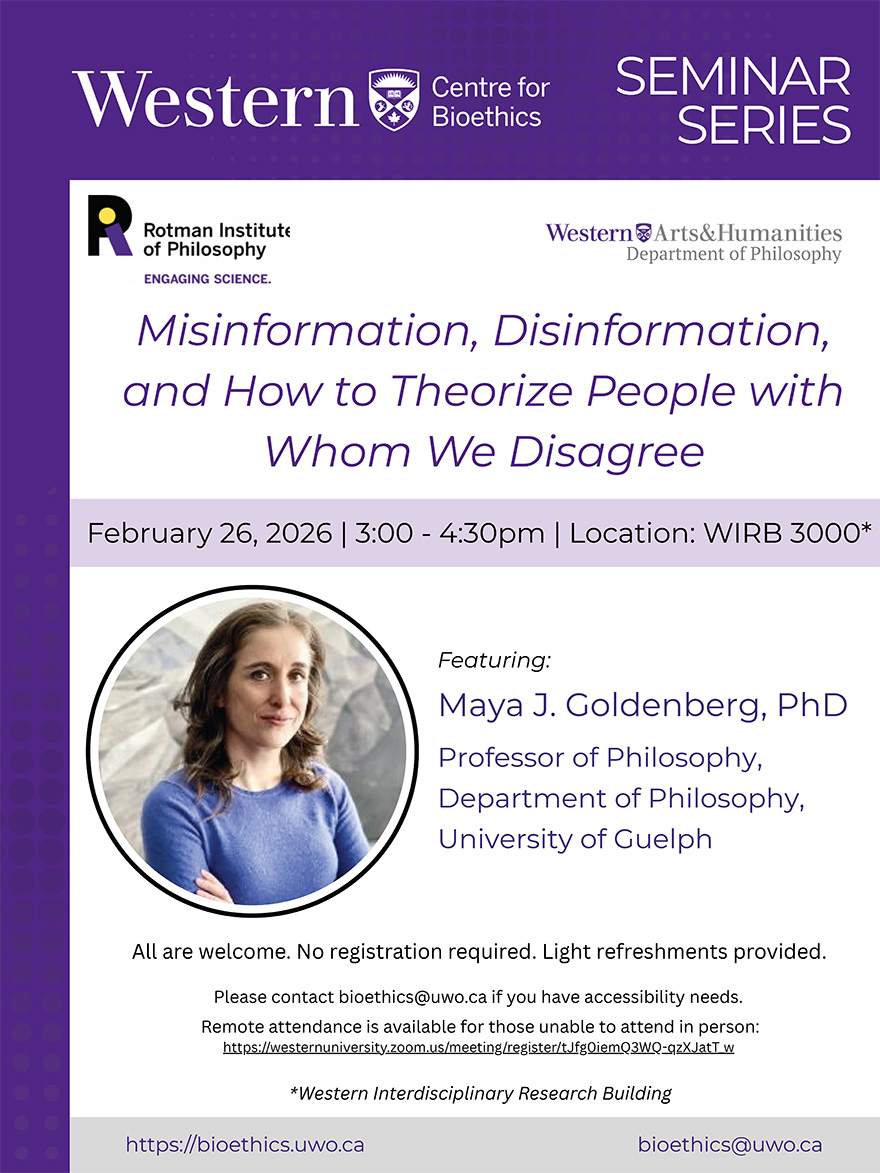
Seminar Series: Misinformation, Disinformation, and How to Theorize People with Whom We Disagree with Professor Maya Goldenberg (Philosophy, University of Guelph)
Prevailing accounts of the contemporary “misinformation age” cast democratic instability as an epistemic crisis: falsehoods purportedly circulate with unprecedented velocity, citizens are said to have lapsed into epistemic negligence, and safeguarding democracy is increasingly framed as a project of truth policing. This talk interrogates that narrative. I argue that the scientific study of misinformation relies on contestable epistemic commitments—chiefly, that the distinction between truth and falsity is sufficiently transparent to be operationalized, and that the diffusion of false content is governed by mechanisms distinct from those structuring the uptake of information more broadly. These assumptions are routinely stabilized through methodologically convenient practices such as relying on fabricated experimental stimuli or outsourcing epistemic adjudication to fact checking institutions, thereby masking the inherent ambiguity, value ladenness, and social embeddedness of real world communication.
I show that post truth discourse generates significant normative and political consequences: it pathologizes dissent through attributions of irrationality or epistemic vice, legitimates forms of epistemic exclusion, and intensifies affective polarization. Against this backdrop, I advance an alternative framework grounded in epistemic trust and causal symmetry—the view that the uptake of both true and false claims is shaped by agents’ prior commitments, social identities, interpretive horizons, and relationships of trust and mistrust. Drawing on feminist epistemology, social epistemology, and political epistemology, I argue that many ostensibly irrational beliefs can be rendered intelligible once situated within fractured epistemic environments and shifting regimes of credibility. I conclude that democratic resilience depends less on enforcing epistemic conformity than on cultivating the relational and institutional conditions that sustain mutual intelligibility and inclusive deliberation across deep disagreement.
Light refreshments will be available.