Search Website
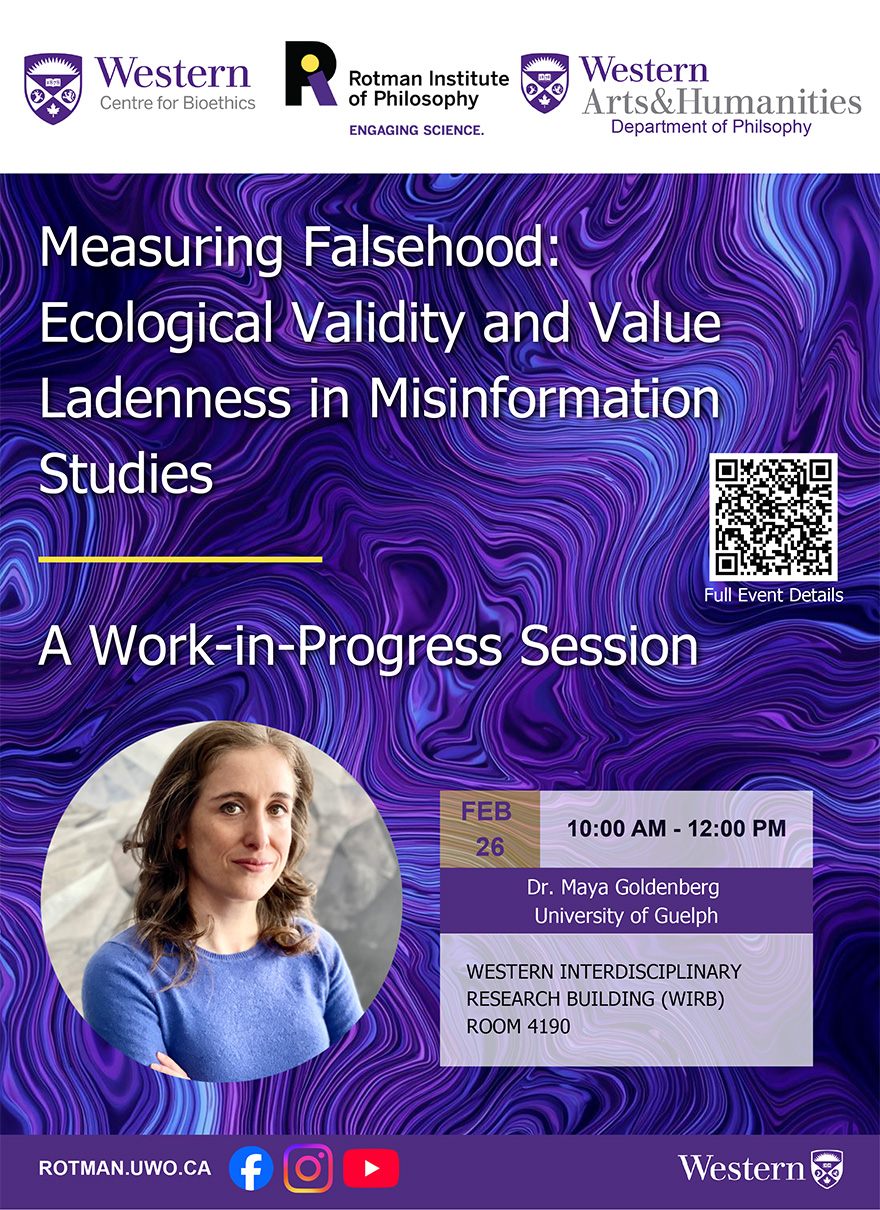
Dr. Maya Goldenberg: Measuring Falsehood: Ecological Validity and Value Ladenness in Misinformation Studies — A Work-in-Progress Session
Featuring: Dr. Maya Goldenberg, University of Guelph.
Misinformation research rests on two mutually reinforcing assumptions: first, that falsehoods are measurable objects that can be reliably operationalized and coded; and second, that false claims spread through distinctive psychological and social mechanisms unlike those governing the uptake of true information. I argue that this measurement centered picture is unstable on both epistemic and democratic grounds. Epistemically, real information ecologies complicate attempts to demarcate truth from falsity. Underdetermination, inductive risk, and the prevalence of malinformation—factually accurate content that misleads through framing or decontextualization—undermine the field’s reliance on fact checking and ground truth adjudication. At the methodological level, practices such as using fabricated stimuli or outsourcing truth judgments to fact checkers obscure the very demarcation problem the field seeks to resolve, reducing ecological validity while importing background value commitments under the guise of neutral measurement.
Democratically, misinformation studies inherit institutionally situated, non ideal priors that shape what counts as a threat, which utterances merit scrutiny, and how harms are individuated. Drawing on standpoint theory and critical contextual empiricism, I show how these value laden assumptions structure credibility assessments and reinforce existing patterns of epistemic exclusion. Interventions centered on prebunking, debunking, and automated detection can thereby amplify credibility excess and deficit dynamics.
These critiques reveal that measuring falsehood is not a straightforward empirical task but a value laden, socially embedded one. I propose reframing misinformation research within a democratic epistemology that foregrounds ecological validity, mutual intelligibility, and the social conditions of epistemic trust. Modeling disagreement under causal symmetry—where the same cognitive and social factors govern uptake of accurate and misleading content—supports a shift from truth policing toward trust repair and epistemic inclusion, without abandoning standards of evidence.