
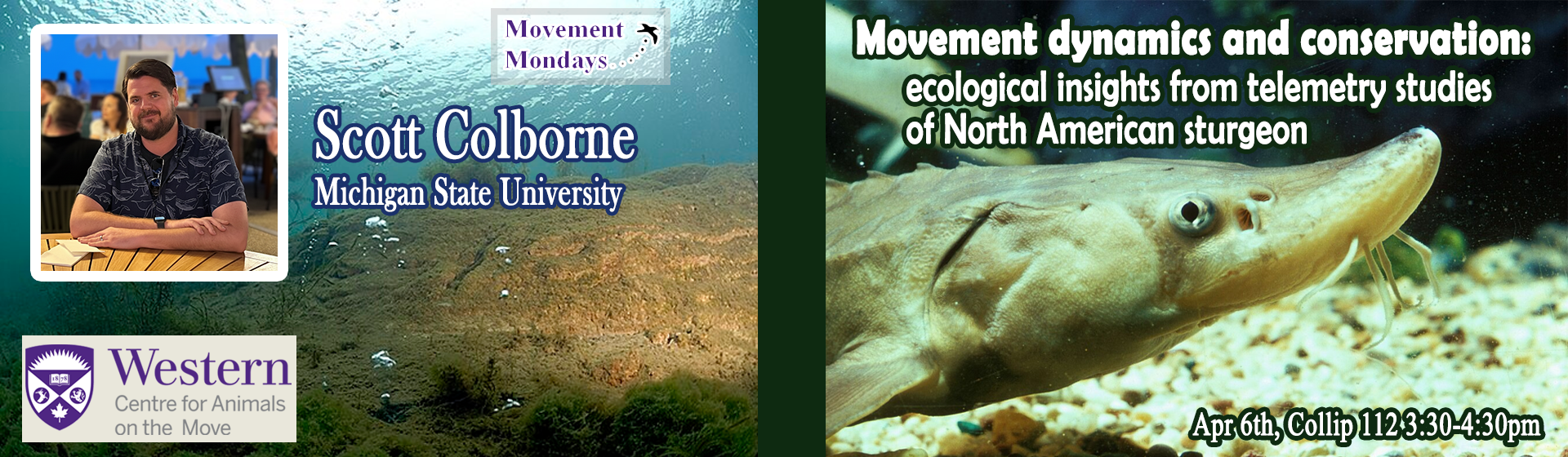
Summary: Understanding how animals move through space and time is central to ecology, particularly for long-lived migratory species whose life histories span multiple habitats and often cross jurisdictions. In this seminar, I will describe my experience with acoustic telemetry studies of North American sturgeon to illustrate how movement serves as a key ecological process linking individuals to populations and informing conservation outcomes. Drawing on work with Lake Sturgeon populations in the Great Lakes and endangered Green Sturgeon in California, I will demonstrate how telemetry has revealed patterns of migration, habitat use, and individual variability in sturgeon. By improving our understanding of how sturgeon interact with contemporary landscapes, these studies provide a foundation for future conservation efforts and strategies with the goals of supporting long-term population persistence. I will conclude by looking forward to ongoing efforts and future directions at Michigan State University, including work with the Great Lakes Acoustic Telemetry Observation System (GLATOS) and the Black River Sturgeon Rearing Facility, as well as collaborations with the University of California, Davis, that continue to advance the use of telemetry in sturgeon conservation.