How Students Take Better Notes in Tough Courses
 Written by: Victoria Lam, 2nd Year Chemistry
Photo by: maks_d on Unsplash
With so many aspects of academics that we students feel we have to optimize, finding a preferred note-taking strategy may feel like one more task on your plate. Luckily, finding the best system(s) for you simply takes exploration and some good old trial and error! Note-taking isn’t one-size-fits-all; it all depends on your learning style and the course content.
The first thing to consider is the different formats in which you can take your notes: handwritten or typed. I’ve noticed that students in information-based classes (e.g. psychology and English) tend to type their notes, as this allows them to write large amounts of text with ease. Conversely, those in application-based classes (e.g. calculus and chemistry) tend to handwrite their notes, so that they can capture information fast with proper formatting. I personally use Google Docs on my laptop for the former as I find it has an easy-to-navigate interface and plenty of storage. For the latter, I love the app Goodnotes on an iPad, as it allows for fast formatting and convenient slide annotation - however, a notebook and pen work just fine as well!
The second thing to keep in mind is that note-taking is rarely as straightforward as just writing down everything the professor says. Take it from me - I tried to do this in a content-heavy course, and found myself retaining so little of the material after focusing on typing that I had to go back and watch weeks’ worth of lecture recordings! Avoid this mistake and set yourself up for success from the beginning of the course by figuring out a system that:
Captures The Key Details Quickly
Besides those three-hour-long classes that appear to drag on forever, lectures go by pretty fast. With that whirlwind speed comes a ton of information, of which some will probably be on the final exam. Notice the key word there: some. Professors can only test so much content on an exam, so pay attention to which concepts your professor spends the most time on, and scale the amount and depth of your notes to this. If they indicate that you’ll only need to understand the big picture of a topic, don’t worry about copying down every single detail! This is also an important factor in more hands-on course components such as labs and tutorials, where you are often in a time crunch to complete an exercise. For example, in my analytical chemistry labs this past year, I started preparing tables in my lab book in advance in order to balance recording observations and completing the experiment on time. The goal is to record what will have you understanding and learning to the fullest.
Keeps You Engaged
Connecting to the previous point, it is often better for your comprehension and retention to focus on the lecture than to write as many notes as possible. Imagine this scenario: if I was “teaching” you the contents of this blog in a lecture, do you think you’d be better able to show what you learned about the topic afterward if you were processing and making mental connections as I’m talking, or if your attention was on writing down all the information? You probably said the first one, because that is the method that has you actually engaging with the content. Translating ideas instead of transcribing words is what will have you truly committing information to memory.
Incorporates Review After Lecture
Post-lecture review of notes is an underrated but effective way to help retain course content for exams and beyond. I didn’t start doing this until my second year at Western - previously, I would just take my notes and file them away until it was time to study. When I came back to them after a few weeks, I had the information written down, but struggled to remember context and examples. Now, I’d suggest implementing a post-lecture review process like this: read over your notes within one day of the class, and add anything you may have missed. Try connecting ideas in them to your textbook or readings. Also, be proactive with your studying by using the notes to make practice questions or flash cards! I do this with the flashcard program Anki to leverage spaced repetition. Consistent review and early practice will help you to gain a full understanding of concepts well before the exam.
Is Easy To Reference And Study From
At the end of the day, the purpose of note-taking is to have a body of information to look back on and study from… so if your notes are disorganized and hard to read, that won’t be easy. Keep them organized with headings and dot jots, add purposeful highlights and dot jots in the margins to distinguish important information, and add visuals such as diagrams. If you have a hard time maintaining this structure in lecture, you can always reorganize the notes in the aforementioned review. Your future self will thank you for the help when it comes time to study!
Some Note-Taking Styles to Try…
While you can absolutely “invent” your own note-taking system, you can also use one that is already established. Some popular methods include:
- The Cornell Method: involves dividing your page into sections for organization and efficiency, as seen in the example below. I especially love the summary section, as it gets you to review and condense ideas into your own words!
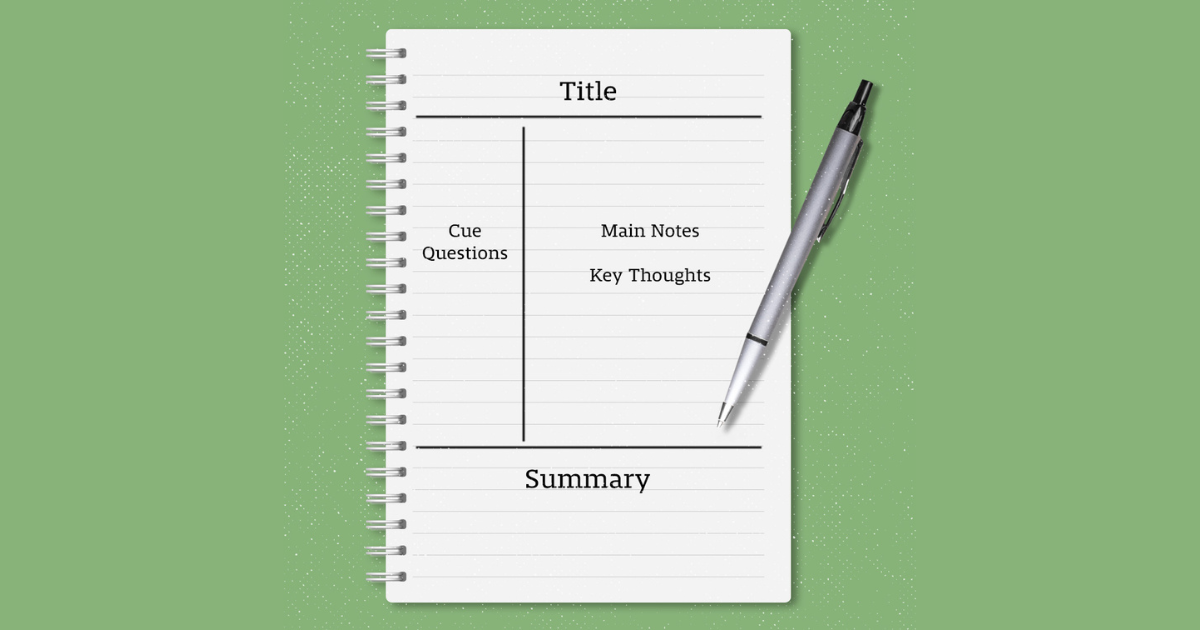 Photo source: Cornell University
- The Outlining Method: involves nesting dot-jots to illustrate relationships between points and specificity.
- The Mapping Method: involves creating a mind-map illustration to visually represent the content.
- The Charting Method: involves setting up a chart to record information, which is perfect for chronological lecture formats where dates and events are connected to facts.
- The Sentence Method: involves writing every new thought and topic as a sentence on a separate line, keeping things clear and concise.
Check out this article from The University of Tennessee at Chattanooga for an in-depth how-to on the methods.
Looking for more note-taking tips? Check out Western’s Learning Development & Success team’s Note-Taking Strategies Handout for additional strategies and tips to help you make the most of your notes.
Happy note-taking, Mustangs!
Published on