




Secondary Ion Mass Spectrometry (SIMS)

Cameca IMS-3f SIMS
SIMS is a surface analytical technique that uses an ion beam to remove material from a surface. The impact of the primary ions generates neutral atoms and positively and negatively charged secondary ions, that are sputtered from the sample surface. Positive or negative ions can then be mass-separated and detected by an electron multiplier or projected onto a phosphorescent screen in order to measure their spatial distribution on the surface.
SIMS has the capability of analyzing all elements in the periodic table as well as all isotopes. Typical detection limits for trace elemental analysis are in the ppm to ppb range.
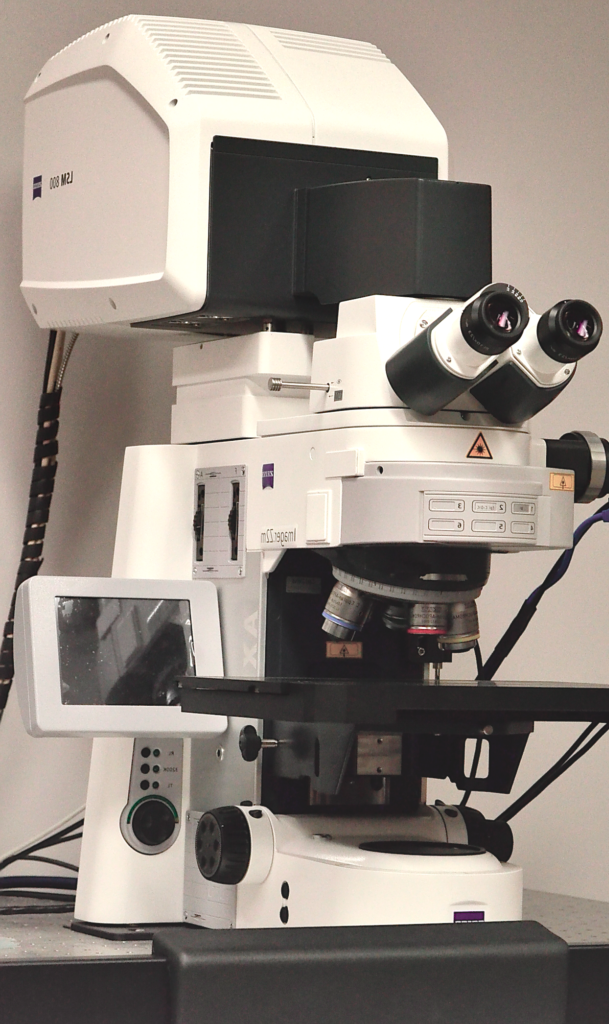
Our instrument used for dynamic SIMS analyses is a Cameca IMS-3f secondary ion mass spectrometer that has undergone significant electrical and computer interface upgrades in response to today's range of a pplications
Types of Analyses
Mass Spectra
- Often the first step in SIMS analysis is to obtain general chemical composition, that can be the basis for further SIMS analyses.
- The mass spectra provide a chemical "fingerprint" for unknown samples.
- Mass spectra can be obtained extending from 1 - 250 atomic mass units (amu).
Depth Profiles
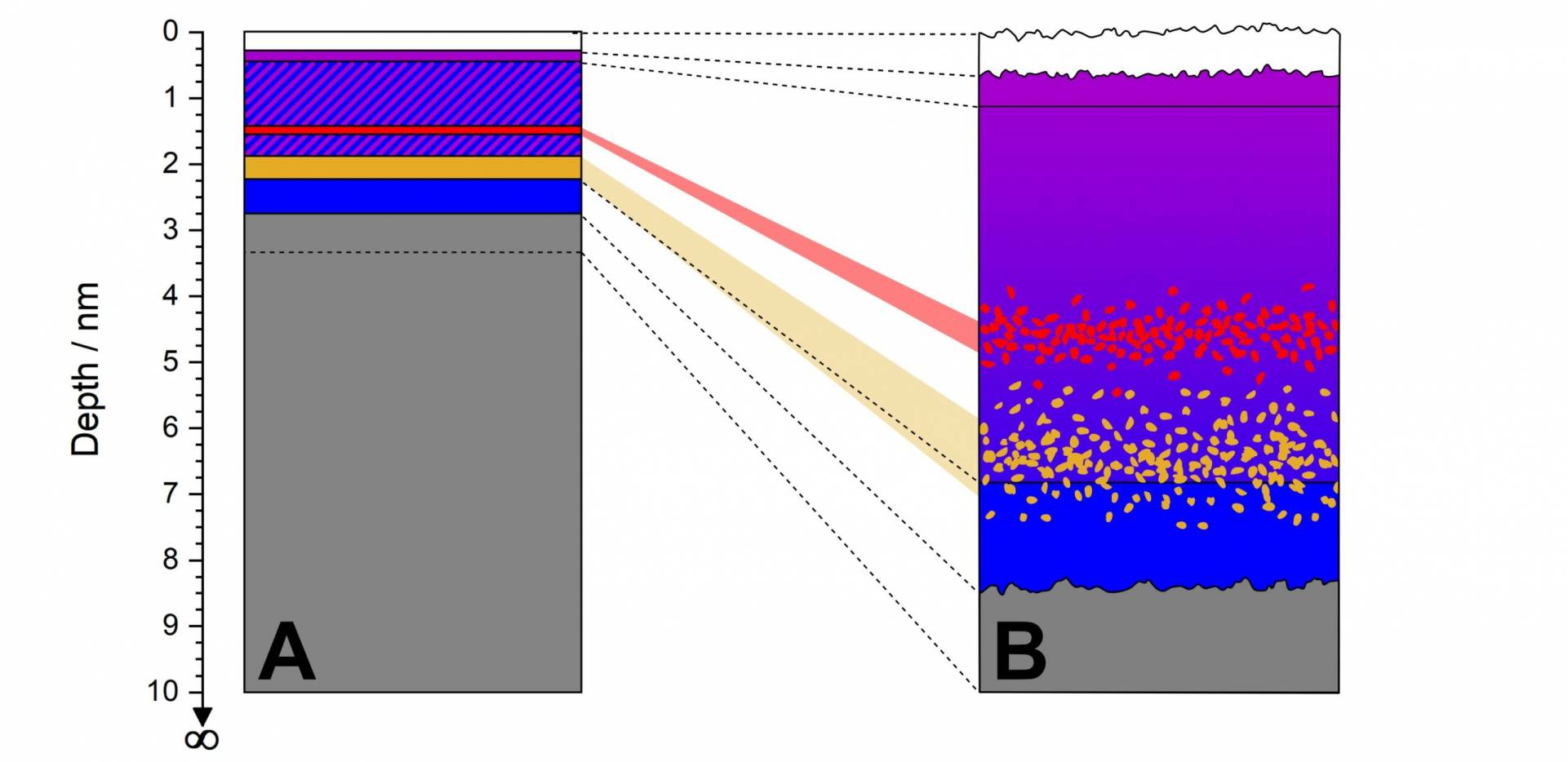
The sputtering process removes material from the surface, constantly exposing new, previously buried layers to analysis by the ion beam. Monitoring the intensity of secondary ions as a function of time provides a profile of elemental concentration (pro viding standards are available) as a function of depth. Sputter rates can be adjusted to analyze depths ranging from nanometres to many microns. Depth profiles can be used to:
- Show impurities present in a particular layer, their concentrations, and their depth distributions
- Measure the thickness of a film (by measuring the depth of the SIMS crater using profilometry)
- Monitor a diffusion profile across an interface
- Show whether segregation occurred at an interface
Imaging
- Two-dimensional (2D) imaging shows the spatial distribution of elements across a surface.
- Images can be overlayed to illustrate the spatial relationship between two or three elements at a time.
- Spatial resolution is ~1µm. Sensitivity can be as low as ppm.
- Three-dimensional (3D) imaging reveals the distribution with respect to depth.
- 3D images can be volume-rendered and shown as a movie of the cylinder in motion. This creates a highly visual aid in understanding elemental distributions throughout the analyzed volume.
Features of SIMS
- Quantification normally requires reference standards because secondary ion yields are substrate dependent. Well-defined standards of each matrix must be used to calculate an unknown concentration from its signal intensity.
- SIMS is a destructive technique; a crater is formed during the analysis. The rastered area ranges from 0 - 500µm.
- The typical analyzed area size is 60µm for depth profiles, and 150µm for imaging.
- A flat surface is required to obtain the best lateral and depth resolution.
- Samples must be <25 mm in diameter and preferably <5 mm thick.
- The range of incident energy of primary ions is:
Positive secondary ions
- 1 - 4 keV/atom for O2+
- 2 - 8 keV/atom for Cs+
- ~17 keV/atom for O-
Negative secondary ions
- ~8.5 keV/atom for O2+
- ~14.5 keV/atom for Cs+
- 2 - 8 keV/atom for O-
Examples of SIMS Analysis
- Negative ion SIMS spectrum of the mineral arsenopyrite
- Negative ion SIMS depth profile of Ni layer on Cu substrate
- Positive ion SIMS depth profile of an aluminum oxide/metal interface
- Images from a tinplated steel sample used for food canning
SIMS Workshop
Surface Science Western and Surface Interface Ontario held a SIMS Workshop on October 19, 2005. More information, including all talks presented.
.:Ross Davidson
Manager, Scientific Operations
Call: (519) 661-2173
Fax: (519) 661-3709
E-Mail us
Customer Testimonials
"The quality, speed and accuracy is amazing"
"Great job! I will be doing more business with you."
more about our customers...